Product

Solutions

Resources

Company

black background

The Document AI platform Textscope®
unlocks the full potential of your documents.​

The Document AI platform Textscope®
unlocks the full potential of your documents.​

Lomin is leading the way toward a future where document data
can be automatically processed and utilized with cutting-edge AI technology.​

Lomin is leading the way toward a future where document data
can be automatically processed and utilized with cutting-edge AI technology.​

black background

The Document AI platform Textscope® unlocks the full potential of your documents.​

Lomin is leading the way toward a future where document data can be automatically processed and utilized with cutting-edge AI technology.​

Trusted by leading organizations

Trusted by leading organizations

Textscope® Studio for Document AI

Textscope® Studio
for Document AI

Document AI models

With an AI model that offers exceptional data extraction capabilities,
various business documents can be processed with minimal training.​

Trade Documents

Identification Card

Type

Commercial Invoice

Bill to

Lomin.ai (06693) 7F, JBI Building, 10, Bangbaecheon-ro 2-gill, Seocho-gu, Seoul, Republic of Korea

Invoice No

734344

Invoice Date

April 21, 2021

Total Quantity

707.340

Items

SPEC

SIZE

QUANTITY

430 BC

3.0 X 1240 X C

426.150

430 BC

3.0 X 1265 X C

186.450

430 BC

3.0 X 1265 X C

94.740
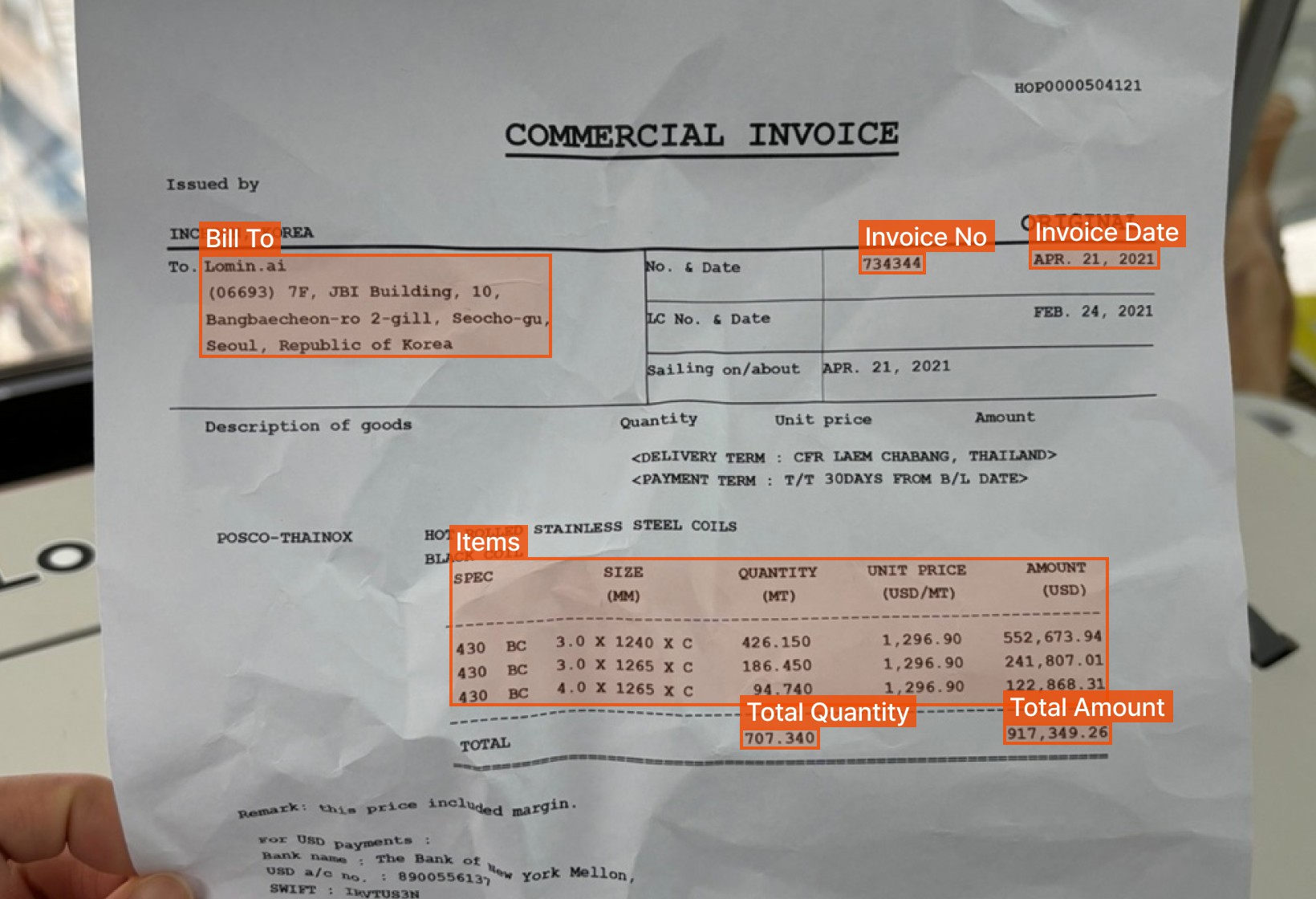
Commercial Invoice OCR result

Document AI models

With an AI model that offers exceptional data extraction capabilities, various business documents can be processed with minimal training.​

Trade Documents

Identification Card

Type

Commercial Invoice

Bill to

Lomin.ai (06693) 7F, JBI Building, 10, Bangbaecheon-ro 2-gill, Seocho-gu, Seoul, Republic of Korea

Invoice No

734344

Invoice Date

April 21, 2021

Items

SPEC

SIZE

QUANTITY

430 BC

3.0 X 1240 X C

426.150

430 BC

3.0 X 1265 X C

186.450

430 BC

3.0 X 1265 X C

94.740

Commercial Invoice OCR result

Solution for your business

문서를 손에 들고있는 모습

Lomin Recognized as Top Performing
IDP Platform by Gartner

Lomin has been recognized as a Top Performing Solution Globally in the Intelligent Document Processing (IDP) Platforms report published by the global IT research firm Gartner.

Lomin joined the NVIDIA Inception
Program as a community member

Lomin has been selected for NVIDIA Inception, a global program supporting innovative AI startups, and is receiving key benefits essential for its growth into a global enterprise.
문서를 손에 들고있는 모습

Lomin Recognized as Top Performing
IDP Platform by Gartner

Lomin has been recognized as a Top Performing Solution Globally in the Intelligent Document Processing (IDP) Platforms report published by the global IT research firm Gartner.

Lomin joined the NVIDIA Inception
Program as a community member

Lomin has been selected for NVIDIA Inception, a global program supporting innovative AI startups, and is receiving key benefits essential for its growth into a global enterprise.

Award & History

Since its establishment in 2018, Lomin has focused exclusively on developing Document AI technology, achieving various milestones. Discover Lomin's achievements and journey, including winning 1st place in the AI Grand Challenge, obtaining NET/NEP certifications, and being featured in the Gartner Report.

Since its establishment in 2018, Lomin has focused exclusively on developing Document AI technology, achieving various milestones. Discover Lomin's achievements and journey, including winning 1st place in the AI Grand Challenge, obtaining NET/NEP certifications, and being featured in the Gartner Report.

Explore Our Latest Insights
Lomin CTO Bee Lim presenting on document AI business automation rate at the KCCV 2026 industry session

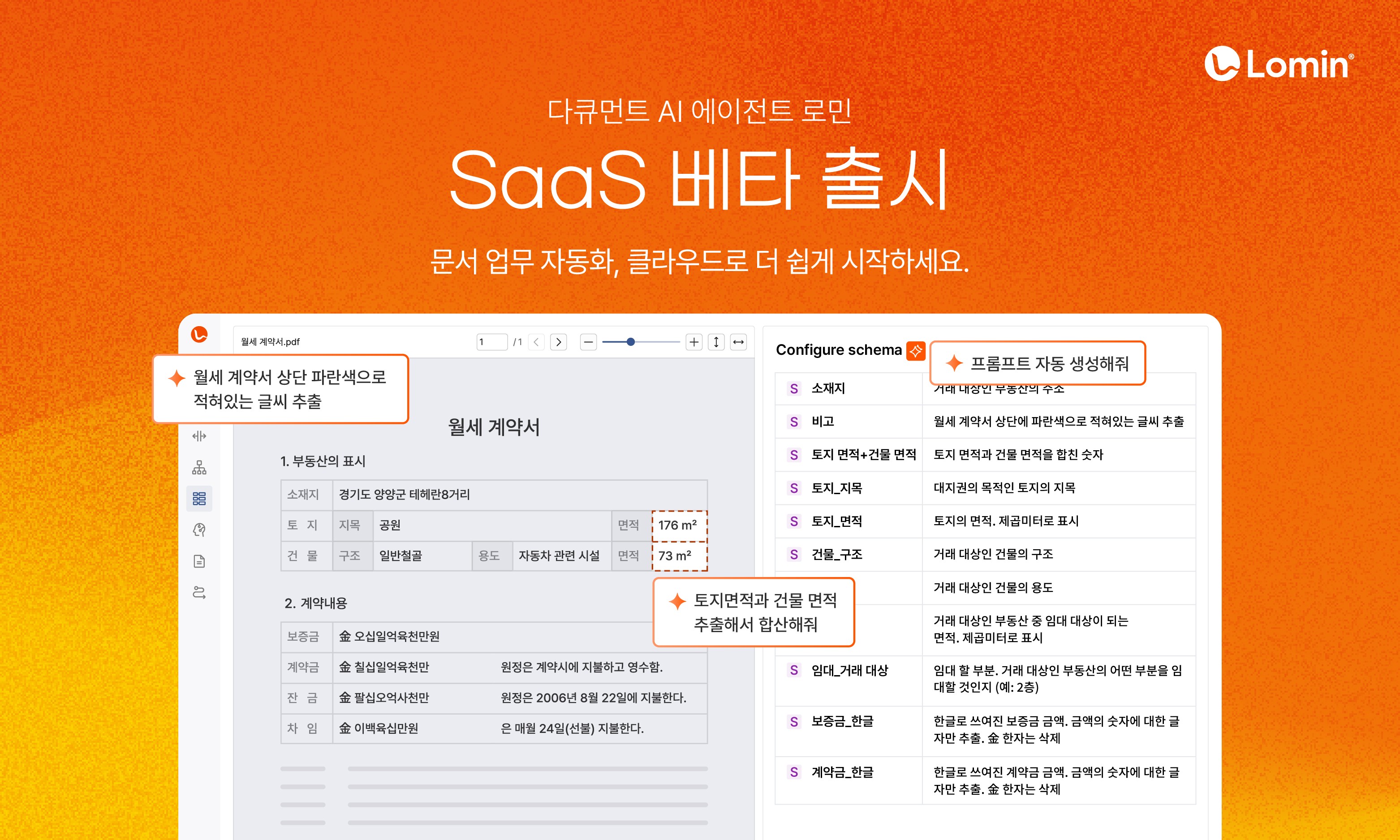
No Server Deployment Required: Lomin Launches SaaS Beta for Document AI

No Server Deployment Required: Lomin Launches SaaS Beta for Document AI

Lomin is expanding its document AI business with the launch of a software-as-a-service (SaaS) version of its AI agent for document processing.

Lomin, a document AI company, announced on Aug. 26 that it has launched a beta version of Lomin, its document AI agent, as a SaaS offering. The company plans to officially launch the service in the second half of this year following the beta period. The move expands Lomin’s document automation technology, previously delivered primarily through on-premises deployments, to cloud-based environments.

Lomin supports the entire document processing workflow, from document parsing and classification to information extraction, comparison, sensitive data de-identification, review and model learning. The processed results can be connected to a company’s existing business systems, enabling automation beyond document review and data entry to downstream business processes.

Lomin’s SaaS service provides a grounding feature that allows users to verify AI-extracted information directly against the original document. It also provides confidence scores for each extracted result, helping users identify which information requires human review. Once reviewed, the extracted information can be sent to existing enterprise systems, including enterprise resource planning (ERP) and groupware systems, as well as other business applications.

The service uses vision-language models (VLMs) to extract information from documents in a variety of formats. It can process complex tables and unstructured documents, while its active learning capabilities use data generated during actual business operations to continuously improve AI performance.

Lomin has built document AI solutions for more than 80 organizations, primarily in the financial and public sectors. The company is now expanding into additional industries, including manufacturing, telecommunications, trade, education and healthcare.

Before launching the SaaS beta, Lomin validated the service in real-world workflows with customers in the healthcare, insurance and trade sectors. The company incorporated customer feedback to improve the service’s functionality and usability. A healthcare customer is currently using the service in its actual operations.

Lomin is also expanding its document AI business into data preparation for generative AI applications. The company recently introduced the Lomin AI Ready Package, which combines its document structuring solution, Lomin Parse, with its sensitive data de-identification solution, Lomin Redact. The package converts enterprise documents into structured, AI-ready data that can be used with generative AI applications and retrieval-augmented generation (RAG) systems.

“Through our deployment-based business, Lomin has validated document AI that goes beyond accurately reading documents to actually improving business operations,” said Jihong Kang, CEO of Lomin. “With the SaaS beta, we aim to make this technology easier and faster for more companies to adopt, while raising the standard for document AI from recognition accuracy to the level of business automation it delivers.”

new

Lomin CTO Bee Lim presenting on document AI business automation rate at the KCCV 2026 industry session

"Accuracy Alone Isn't Enough" — Lomin Presents a Practical Approach to Document AI

Lomin Participates as Platinum Sponsor of KCCV 2026, Unveils Strategy Built on Grounding and Confidence Estimation

The performance of document AI should be measured by the level of real business automation it delivers, rather than by accuracy alone. The argument rests on reducing the human review burden through technology that isolates only the results most likely to contain errors.

Lomin announced on the 7th that it participated as a Platinum Sponsor of KCCV 2026, the annual conference of the Korean Computer Vision Society, held at BEXCO in Busan from the 3rd to the 5th, where the company delivered an industry session presentation and operated an exhibition booth.

In the industry session, held under the title "Document Understanding: Vision-Language Challenges in Real-World Environments," Lomin explained enterprise document AI outcomes through the lens of the business automation rate — the share of documents that can be processed without a person having to review or correct them.

Im Bi, Chief Technology Officer of Lomin, stressed the point: "Even if document recognition accuracy reaches 99%, if you cannot identify which documents contain the errors, every document has to be checked again by a person. In that case, the model's average accuracy is high, but the actual business automation rate can remain at 0%."

The CTO identified grounding and confidence estimation as the core technologies for raising that rate. Grounding shows where in the source document a piece of AI-extracted information came from. Confidence estimation selects only the results with a high probability of error and routes them to a human for review.

"In confidence estimation, what matters is not designing the model to assign high scores to correct results, but designing it to assign low scores to results that are actually wrong," he explained. "That allows enterprises to progressively expand the set of documents that require no human verification, within an acceptable risk threshold."

During the event, Lomin also unveiled its Document AI Agent platform at its exhibition booth. The platform supports the entire document processing cycle, including document parsing and classification, information extraction and comparison, de-identification of sensitive information, and AI training.

The company additionally hosted an on-site meetup to recruit AI researchers at the master's and doctoral level as well as specialized research personnel. This year's KCCV featured roughly 170 papers and drew some 1,300 participants, the largest turnout in the conference's history.

CTO Im, who delivered the presentation, is the first author of "EDSR," a paper on image super-resolution. The paper has been cited more than 15,000 times according to Google Scholar, and the work earned him the Sang-Uk Lee Best Paper Award at KCCV in 2022.

"What enterprises expect from document AI is not simply high accuracy, but how reliably it can automate actual business work," Im said. "Building on the experience we have accumulated in the field, we will continue to advance document AI technology optimized for enterprise environments."

new

Lomin CTO Bee Lim presenting on document AI business automation rate at the KCCV 2026 industry session

No Server Deployment Required: Lomin Launches SaaS Beta for Document AI

No Server Deployment Required: Lomin Launches SaaS Beta for Document AI

Lomin is expanding its document AI business with the launch of a software-as-a-service (SaaS) version of its AI agent for document processing.

Lomin, a document AI company, announced on Aug. 26 that it has launched a beta version of Lomin, its document AI agent, as a SaaS offering. The company plans to officially launch the service in the second half of this year following the beta period. The move expands Lomin’s document automation technology, previously delivered primarily through on-premises deployments, to cloud-based environments.

Lomin supports the entire document processing workflow, from document parsing and classification to information extraction, comparison, sensitive data de-identification, review and model learning. The processed results can be connected to a company’s existing business systems, enabling automation beyond document review and data entry to downstream business processes.

Lomin’s SaaS service provides a grounding feature that allows users to verify AI-extracted information directly against the original document. It also provides confidence scores for each extracted result, helping users identify which information requires human review. Once reviewed, the extracted information can be sent to existing enterprise systems, including enterprise resource planning (ERP) and groupware systems, as well as other business applications.

The service uses vision-language models (VLMs) to extract information from documents in a variety of formats. It can process complex tables and unstructured documents, while its active learning capabilities use data generated during actual business operations to continuously improve AI performance.

Lomin has built document AI solutions for more than 80 organizations, primarily in the financial and public sectors. The company is now expanding into additional industries, including manufacturing, telecommunications, trade, education and healthcare.

Before launching the SaaS beta, Lomin validated the service in real-world workflows with customers in the healthcare, insurance and trade sectors. The company incorporated customer feedback to improve the service’s functionality and usability. A healthcare customer is currently using the service in its actual operations.

Lomin is also expanding its document AI business into data preparation for generative AI applications. The company recently introduced the Lomin AI Ready Package, which combines its document structuring solution, Lomin Parse, with its sensitive data de-identification solution, Lomin Redact. The package converts enterprise documents into structured, AI-ready data that can be used with generative AI applications and retrieval-augmented generation (RAG) systems.

“Through our deployment-based business, Lomin has validated document AI that goes beyond accurately reading documents to actually improving business operations,” said Jihong Kang, CEO of Lomin. “With the SaaS beta, we aim to make this technology easier and faster for more companies to adopt, while raising the standard for document AI from recognition accuracy to the level of business automation it delivers.”

new

Lomin CTO Bee Lim presenting on document AI business automation rate at the KCCV 2026 industry session

"Accuracy Alone Isn't Enough" — Lomin Presents a Practical Approach to Document AI

Lomin Participates as Platinum Sponsor of KCCV 2026, Unveils Strategy Built on Grounding and Confidence Estimation

The performance of document AI should be measured by the level of real business automation it delivers, rather than by accuracy alone. The argument rests on reducing the human review burden through technology that isolates only the results most likely to contain errors.

Lomin announced on the 7th that it participated as a Platinum Sponsor of KCCV 2026, the annual conference of the Korean Computer Vision Society, held at BEXCO in Busan from the 3rd to the 5th, where the company delivered an industry session presentation and operated an exhibition booth.

In the industry session, held under the title "Document Understanding: Vision-Language Challenges in Real-World Environments," Lomin explained enterprise document AI outcomes through the lens of the business automation rate — the share of documents that can be processed without a person having to review or correct them.

Im Bi, Chief Technology Officer of Lomin, stressed the point: "Even if document recognition accuracy reaches 99%, if you cannot identify which documents contain the errors, every document has to be checked again by a person. In that case, the model's average accuracy is high, but the actual business automation rate can remain at 0%."

The CTO identified grounding and confidence estimation as the core technologies for raising that rate. Grounding shows where in the source document a piece of AI-extracted information came from. Confidence estimation selects only the results with a high probability of error and routes them to a human for review.

"In confidence estimation, what matters is not designing the model to assign high scores to correct results, but designing it to assign low scores to results that are actually wrong," he explained. "That allows enterprises to progressively expand the set of documents that require no human verification, within an acceptable risk threshold."

During the event, Lomin also unveiled its Document AI Agent platform at its exhibition booth. The platform supports the entire document processing cycle, including document parsing and classification, information extraction and comparison, de-identification of sensitive information, and AI training.

The company additionally hosted an on-site meetup to recruit AI researchers at the master's and doctoral level as well as specialized research personnel. This year's KCCV featured roughly 170 papers and drew some 1,300 participants, the largest turnout in the conference's history.

CTO Im, who delivered the presentation, is the first author of "EDSR," a paper on image super-resolution. The paper has been cited more than 15,000 times according to Google Scholar, and the work earned him the Sang-Uk Lee Best Paper Award at KCCV in 2022.

"What enterprises expect from document AI is not simply high accuracy, but how reliably it can automate actual business work," Im said. "Building on the experience we have accumulated in the field, we will continue to advance document AI technology optimized for enterprise environments."

new

5F, Jaewoo Building, 32, Saimdang-ro, Seocho-gu, Seoul

Product & Technical Consulting

T. +82) 2 6289 0501

General Inquiry

T. +82) 2 6331 1853

© 2026 Lomin, Inc. All rights reserved

5F, Jaewoo Building, 32, Saimdang-ro, Seocho-gu, Seoul

Product & Technical Consulting

General Inquiry

© 2026 Lomin, Inc. All rights reserved